Tuesday, 26 April 2016

JetBrains dotMemory not attaching = reload .NET perf counters

If you get an issue using dotMemory where it wont connect to the profiler, then run the following two commands from a .net command prompt…
unlodctr .NETFramework
lodctr C:\Windows\Inf\.NETFramework\corperfmonsymbols.ini

Friday, 22 January 2016

Wednesday, 13 January 2016

Extract job titles from AD using powershell

For a given list of userids in a file called users.txt use the following powershell command in the same directory


Get-Content users.txt | foreach {Get-ADUser -Identity $PSItem -Properties mail,title | select -Property mail, title} |Export-Csv users.csv

Or use this to find new starters in the organisation...

$lastWeek = (get-date).AddDays(-31);

Get-ADUser -Filter "Description -like 'London'"  -Properties Name, Title, Manager, whenCreated, DistinguishedName, LastLogonDate | ? whenCreated  -gt $lastWeek | select Name, Title, Manager, whenCreated, DistinguishedName, LastLogonDate | fl

Note: For windows 7 desktop users you’ll need to install the active directory modules for powershell by following the installation steps here
https://www.microsoft.com/en-gb/download/details.aspx?id=7887
For all active directory attributes / propery names, see this link here
http://www.kouti.com/tables/userattributes.htm
Another way to have done it would have been usng SQL via a linked server
https://www.mssqltips.com/sqlservertip/2580/querying-active-directory-data-from-sql-server/
e.g.
SELECT     *
FROM OPENQUERY( ADSI,
    'SELECT samaccountname, mail, title, sn
     FROM ''LDAP://dc=companyname,dc=com''
     WHERE objectCategory = ''Person'' AND objectClass= ''user''
     AND userprincipalname = ''*'' AND mail = ''*'' AND SN = ''*''
         ORDER BY useraccountcontrol
      ')
      Where
      samaccountname= ‘myaccountloginname’

Wednesday, 6 January 2016

Powershell cruise control build output parser

<#
.Synopsis
   Write-XmlPathOutput processes all files in a directory for a given XPath expression and puts the results to .txt files of the same name
.EXAMPLE
   Write-XmlPathOutput -DirectoryPath DirectoryPath -XPath //*/project
.INPUTS
   DirectoryPath - the path to the directory
   XPath - the xpath you wish to use
.OUTPUTS
   .txt text files in the same directory
#>
function Write-XmlPathOutput
{
    [CmdletBinding(DefaultParameterSetName='Parameter Set 1',
                  SupportsShouldProcess=$false,
                  PositionalBinding=$false,
                  HelpUri = 'http://merrickchaffer.blogspot.com/',
                  ConfirmImpact='Medium')]
    [OutputType([String])]
    Param
    (
        # Param1 help description
        [Parameter(Mandatory=$true,
                   ValueFromPipeline=$true,
                   ValueFromPipelineByPropertyName=$true,
                   ValueFromRemainingArguments=$false,
                   Position=0,
                   ParameterSetName='Parameter Set 1')]
        [ValidateNotNull()]
        [Alias("p")]
        [String]
        $DirectoryPath = (Get-Location).Path,

        # xpath help description
        [Parameter(Mandatory=$false, ParameterSetName='Parameter Set 1', Position=1,
                    ValueFromPipeline=$true,
                   ValueFromPipelineByPropertyName=$true,
                   ValueFromRemainingArguments=$false )]
        [Alias("x")]
        [String]
        $XPath = "//*/project/@file"

    )

    Begin
    {
    }
    Process
    {
        if ($pscmdlet.ShouldProcess("Target", "Operation"))
        {
            $files = Get-ChildItem (Get-ChildItem $DirectoryPath\*.xml)
            if ($files -ne $null -and $files.Length -gt 0) {
               
                ForEach ($file in $files) {
                 
                  $OutFile = [string]::Concat($file.FullName, ".txt")
                 
                  Select-Xml -Path $file.FullName -XPath $XPath | Select -ExpandProperty Node | Out-File $OutFile

                }
            }

        }
    }
    End
    {
    }
}

Write-XmlPathOutput -DirectoryPath C:\temp -XPath "//*/project/@file"

Thursday, 31 December 2015

Great electrician

Spoke with these guys yesterday on their day off
http://www.checkatrade.com/RKBuilders/
image
and they still gave me great advice which helped me with some light fitting that I had spent the morning struggling with.
Can thoroughly recommend their services. Father and son team, and I spoke to the son, who really knew his stuff when it came to GU10 halogen downlight bayonet fitting.

Wednesday, 16 December 2015

Speech with windows powershell

Set-ExecutionPolicy Unrestricted -Force

<#
.Synopsis
   Allows you to speak on a remote computer
   Requires that you have run winrm qc on the remote machine
   or Enable-PSRemoting. And on the local machine you've changed
   Set-Item -Path WSMan:\localhost\Client\TrustedHosts -Value * -Force 
.DESCRIPTION
   Allows you to speak on a remote computer
.EXAMPLE
   Speak-Remote 1 "How are you today" REMOTE_PC
.EXAMPLE
   Speak-Remote -RemoteComputerName REMOTE_PC
#>
function Speak-Remote
{
    [CmdletBinding()]
    [OutputType([int])]
    Param
    (
        # Param1 help description
        [Parameter(Mandatory=$true,
                   ValueFromPipelineByPropertyName=$true,
                   Position=0)]
        [string]
        $Times = (Read-Host "How many Times"),

        # Param2 help description
        [Parameter(Mandatory=$true,
                   ValueFromPipelineByPropertyName=$true,
                   Position=1)]
        [string]
        $Message = (Read-Host "What should I say"),

        [Parameter(Mandatory=$true,
                   ValueFromPipelineByPropertyName=$true,
                   Position=2)]
        [string]
        $RemoteComputerName
    )

    Begin
    {
    }
    Process
    {
        Invoke-Command -ScriptBlock {Param($msg, $n) Add-Type -AssemblyName System.Speech; $o = New-Object -TypeName System.Speech.Synthesis.SpeechSynthesizer; $o.SelectVoice("Microsoft Zira Desktop") ; $y = 0; do { $o.Speak($msg);$y = $y + 1;} until ($y -eq $n) } -ComputerName $RemoteComputerName -ArgumentList $Message, $Times
    }
    End
    {
    }
}

Speak-Remote -RemoteComputerName REMOTE_PC

Thursday, 3 September 2015

How to convert C# bool to Javascript boolean in Razor .cshtml views

I was wanting a clean way to convert a C# Boolean property on a view model into a javascript true / false bit of text for passing into our Typescript context settings constructors, and stumbled upon this way …

@Json.Encode(Model.BoolPropertyName)

clip_image002

Works a treat too!

clip_image004

Monday, 20 July 2015

The case of the disappearing TFS task board

So after wondering where all our tasks had disappeared to, it turns out that someone had changed the default Area path, and ticked it in the _admin/_areas section of the portal.

This has the knock on affect of removing any items from the task board that are not under ticked area paths, hence the stuff that was in our task board disappeared, even though the items were all still there in TFS and accessible via team explorer.

Wednesday, 15 July 2015

Work Item finding with advanced search criteria in Visual Studio 2013

Hi guys

Something that's proving very useful to me now is the fact that you can use advanced search functionality in the quick search box in Visual Studio 2013 to find tickets that you're after.

Example 1,

1. Hit Ctrl+# to enter the team explorer search box

2. Drop down the arrow, and click the assigned to
image

3. Hit enter

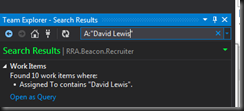
This will then find all the work items assigned to you by default, although you can change the name to someone else to see what they're working on e.g.
image

Example 2 ,

1. Hit Ctrl+# to enter the team explorer search box

2. Type "Stack Rank":3.75

3. Hit Enter

You'll then get back all items where the stack rank is equal to 3.75

clip_image006

Other search examples as follows:

For all work items that have been changed on a given date

"Changed Date":2015-07-14

For all work items authorized by someone

"Authorized As":"Name Here"

For all bugs changed today

T:"Bug" "Changed Date":2015-01-14

For all items that you uploaded to TFS today

"Authorized As":"@Me" "Changed Date":2015-07-14

That last one is particularly useful, if you've just forgotten the task number you checked in and closed

image

How to find the last interactive logons in Windows using PowerShell

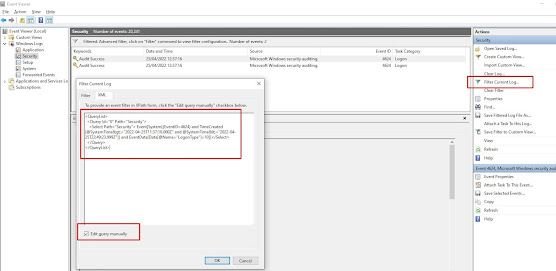
Use the following powershell script to find the last users to login to a box since a given date, in this case the 21st April 2022 at 12pm un...